Meet a Backslider: Interview #5
Meet the Backsliders is an interview series I’ve created for anyone who’s ever wondered, “What if climbing the ladder isn’t the point?” Each interview explores how smart, driven people got tired of chasing success that didn’t feel like success to them and what happened when they decided to backslide in their careers on purpose. If you missed the first three Backslider interviews, you can read them here, here, here, and here.
Every Backslider featured here has shared their story with generosity and truth, in a Q&A format. Their words are their own (with light editing for tone and flow from yours truly) - with identifying details kept vague to honor privacy (when requested).
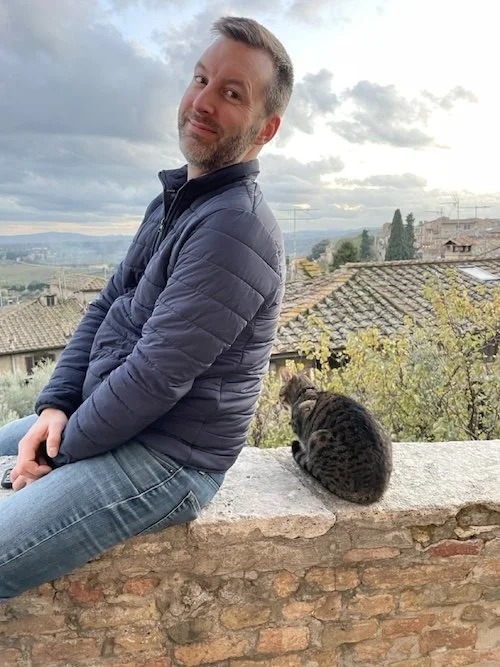
Meet Colin: He grew up believing hard work was the antidote to laziness and spent years moving goalposts in pursuit of validation, security, and success. A speaker, writer, and former stand-up comic, Colin built a career at the height of hustle culture—until losing his work forced him to confront how tightly his identity was fused to his job. Today, he’s learning to treat work as work, channel ambition toward creativity and mental health, and define success as having enough to fund a life he actually wants to live.
This next Backslider interview is with someone I know very well…my husband, Colin Ryan. For nearly our entire relationship, we’ve been entrepreneurs in our separate businesses. This has meant navigating all kinds of challenges (and joys) that come along with taking this risk, including navigating what success means.
Colin is a gifted storyteller and that comes through in his interview. I hope you enjoy!
Q1: Can you describe your history with ambition?
Here's what I learned about myself: no amount of hard work would ever be enough to prove I wasn't lazy. Eight years ago I wrote a book—the book I was supposed to write, given my career. Financial advice offered in an engaging way. I sold copies via speeches and felt good about the impact. But it left me strangely unfulfilled. I'd done what I was supposed to do instead of what I felt compelled to do, which was to write something personal and vulnerable.
Writing the second book (the one I knew wouldn't make money and wrote purely because it mattered to me) that's what helped me see that I had changed.
Let me back up.
I was fortunate to be a smart kid. An avid reader, a good communicator, with a sense of humor that could win people over. This helped me compensate for poor organizational habits, a mind prone to daydreaming, and a powerful tendency toward procrastination.
My challenges with bad grades and failed attempts to "knuckle down" happened at a formative time, and led me to believe I was fundamentally lazy. As a result, learning to work hard made me feel better about myself, but never for very long.
I finally became ambitious when I connected the dots between creativity, effort, and reward. Doing stand-up comedy in my twenties delivered laughs so intoxicating that I worked relentlessly at the craft for years.
I launched a business as a speaker in 2012, and I worked harder at this than anything I'd ever attempted. This was peak hustle culture, when "grinding" 10 hours a day on your business was considered admirable, even inspiring. Financial security and external validation justified what had become an obsessive relationship with work. I could finally feel certain that I wasn’t lazy. But that certainty never materialized. I wasn't used to letting accomplishments sink in, instead just finishing one and setting a new goal. Moving the goalpost forever.
“Without treating my job like my identity, I wouldn’t have had the bandwidth to write this book. I did it because it meant something to me, not because it would lead to mass acclaim or revenue.”
Q2: Was there someone in your life who pushed you toward being ambitious in a certain way?
I grew up with parents who were very, very hardworking. We weren't encouraged to celebrate our accomplishments as much as put our head back down and chase the next thing. As soon as you reached the goalpost, you moved the goalpost. It even happened when attending Evangelical church with my mom. We didn't applaud performances, because that would give glory to people instead of God. It seeped in. Even when I would get applause as a speaker, I would feel horribly embarrassed and try to downplay it.
When I hired my first business coach, he helped me learn the business of paid speaking, for which I'm grateful. But then he immediately had a second program called the Next Level, and the upsell process began. For years, I was told by every coach and trainer that success meant I should scale so I could make more while working less, even though this involved things I might not want to do (like manage a team) and the stress that would come with a greater workload and an ever-growing number of clients I'd have to deliver for.
They’d throw a lot of big numbers at me, and so I read the books and did the coaching sessions and worked harder than I ever had, but it never seemed to be enough. I felt like something was wrong with me a lot. I wasn’t where I wasn’t capable of being. I hadn't realized my full potential. All of these seemingly hopeful messages made me feel bad about myself and made contentment seem like giving up.
All my coaches were reinforcing my veneration of ambition and financial success. I couldn’t see yet see that they were moving my goalpost for me, and that I was helping them do it.
Q3: Was there a specific moment or breaking point that pushed you to think about how you defined success for yourself, or did it happen gradually?
Lindsey was the catalyst, actually. For the first several years of our relationship, and then well into our marriage, she was my fellow endless worker. We would work all day to grow our businesses, and at the end of the work day all our updates were work-related. Then she began to talk differently about work, saying things like "Your job won't love you back." Since I drew identity and meaning and excitement from my work, I didn't want to hear this. It was a language I didn't understand.
I watched as she developed hobbies outside of work, while I did not. Her fulfillment around devoting time to non-monetizable things slowly began to inspire me instead of confuse me, but I still didn’t really comprehend the journey she was on.
And then, my career hit the lowest possible low. After more than a decade as a successful speaker, my business completely disappeared. I did 4 speeches during the first half of that year (the least I’d ever done), and then for the next 4 months I had no gigs, no discovery calls about future gigs, no income. My savings and my mental health plummeted. I had had a fantastic career, and suddenly it was over and I felt like a failure. I recognized how losing your work could be like losing your identity. My job not only didn’t love me back, it had dropped me without warning.
Eventually, I began to rally and to market my business every day, with more discipline than I'd had in years, and the work (and my confidence) re-emerged. I climbed out of the hole, but I left something down there: the idea that the purpose of my work is to achieve some grand, world-changing goal or else my life is incomplete. My relationship to my job improved once I started looking at is merely a job. Moments of fulfillment, moments of impact, a level of creativity, but ultimately my speeches and workshops are what allow me to fund the other parts of my life that I didn't want to connect to making money. I have so much to be proud of and grateful for, and work turns out to be only a part of it.
Q4: How did you decide what kind of work or environment you wanted instead?
I decided to listen to what brought me joy. I loved being creative. I hated how it felt when I told myself I wasn't doing well enough at my business (which persisted even when I was doing well), so I slowly trained myself to stop listening to that voice. I decided to emphasize what helped me feel comfortable in my own skin. Whatever helped me feel happy more often and for longer. This sometimes meant quitting work at 2pm, at other times it meant developing a habit of writing on Sunday afternoons on the new book project I was starting to care a lot about. It only had to make sense to me.
Q5: What has been the hardest part about letting go of the climb — whether that was status, money, or identity? And was it a “one and done” letting go or something you’ve had to do over and over?
I had a really interesting experience a few months ago. I saw a guy at my coworking location who I've seen a few times before. He is a franchise manager for Dale Carnegie, which is all about people skills and influence but also about growing your business. When he recognized me, he asked about my job. When I told him I was a solopreneur and professional speaker, I watched him switch into business mode. He took a step forward, his inflection changed slightly, and he said:
"Colin, what would it be like for you if you could earn more money while working less? What would you want your business to deliver for you that you're not experiencing right now?"
It was the same type of question I'd heard many times throughout my journey, but I saw it so clearly in this moment as merely a way of creating a problem and then selling a solution. I looked at him and said, with a clarity I might not have had before:
“Actually I don't want to scale at all. I like the work I do, and the only thing I'm really focused on is making enough money to keep doing it."
He looked baffled. I was speaking a different language, just like Lindsey had once spoken to me. He quickly moved along, but I was struck by the feeling that I had changed my inner script. It's not easy to unlearn your programming, but it's miraculous to trust yourself and define success on your own terms.
Even still, the voice of self-doubt can always emerge. But the more I lean into being ambitious about the things I care about and unambitious about the things that haven't brought me joy, the more convinced I feel.
Q6: When that gremlin voice shows up — comparing yourself to old colleagues or your past self — how do you quiet it?
To me, that voice so closely resembles my depression’s voice that I consider it my job to notice when it’s talking and let it pass by without giving it weight. I remind myself that no one is what they appear to be on the surface—including the person I was! That version of me looked pretty great on the outside, but I was miserable a lot of the time. I also practice what most helps my mental health: redirecting shame and judgment into observation and acceptance. "Colin is feeling inadequate today." Not "I'm a failure," just noticing what's happening without making it mean something about my worth.
And to delete my Facebook app. And then again, as needed. 😂
Q7: What are you ambitious about these days, if not work? In other words, what has backsliding given you that the old version of success never could?
In 2023, I started writing a book about my mental health journey—something I'd always wanted to do. I'd spent decades struggling with depression and anxiety without knowing why. I tried religion, therapy, stand-up comedy, relationships, financial success, getting applause for a living. Some helped, some didn't. Eventually I figured out my diagnoses, learned to befriend my brain, and emerged more functional and happy than I could have hoped. I wanted to tell that story. So I wrote a bunch of funny, true stories exploring those experiences and explaining the tools that helped me reframe my life.
My ambition, in this case, was channeled into something that was purely for me. I worked incredibly hard on this. Perhaps the hardest I ever have. But here's the thing: I genuinely don't mind if this book makes money or not. It's something I always wanted to do and felt like it was a gift I could give to the many people who experience mental health challenges. It was my way of saying "You're not broken and you're not alone, so come laugh for a few hours and feel uplifted and recognize that you're probably already doing more right than you think you are."
“If I was still treating my job like my identity, I wouldn’t have had the bandwidth to write this book. But instead, I did it purely because it meant something to me, and hopefully will to others, not because it would generate glory or revenue.”
Q8: What would you say to someone who feels trapped in a high-pressure career but is scared to take a step back?
A therapist once challenged me to sit and think until I came up with my truest response to impossible questions about what to do with my life. What eventually came out was this: "I don't know, and I can't know, so why not just do an experiment in this new direction and see how it feels?"
If you're feeling the pain of unrealized potential or those golden handcuffs are feeling a bit tight, recognize that this causes shame and simply be kind to yourself in response. If you need the money right now, that's fine. What if that’s okay? Maybe devote a little time to things that bring you joy, and let that become more of who you are than your salary or title.
Q9: What did we miss? Anything else you'd like to share?
I hope you'll read my book, Epic Tiny Victories, or get it for a friend who would benefit from a laugh and a pick-me-up. You can read the first chapter for free at: www.epictinyvictories.com.
Do you have your own story of intentionally backsliding? I’d love to hear it.
You might be in a season of intentional backsliding if:
You stepped away from the grind (by choice or by circumstance) and feel unexpectedly at peace
You reached the milestone you were chasing and felt… underwhelmed
Your ambition now shows up in quieter places: caring for others, tending your health, resting, creating, building community
You’re not in crisis, but you sensed where things were headed—and decided to slow down before your body forced you to
If any of this resonates, you’re not behind. You’re paying attention.
If you’d like to share your story for this Meet the Backsliders series, email me at lindsey(at)lindseylathrop.com.